
The group of Ute Lechner
Regulation of organohalide respiration
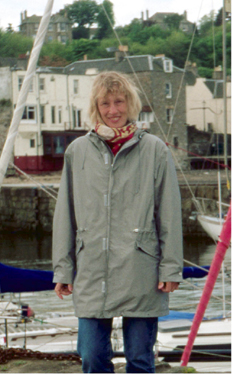
Ute Lechner retired in spring 2018. Her colleagues have celebrated this new phase of her life together with her, but are also very sad not to see and discuss science and life with her on a daily basis anymore. (CP)
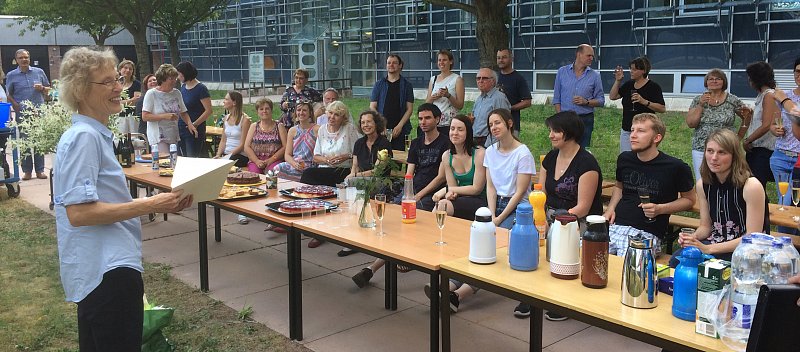
Dr. Lechner's retirement party.
|
Many anthropogenic halogenated organic compounds posses a high toxicity and accumulate in anaerobic habitats. Some specialised anaerobic bacteria like Dehalococcoides and Desulfitobacterium are capable to use these compounds as terminal electron acceptors in an anaerobic respiration, called organohalide respiration. In this process the organohalides are stepwise dehalogenated and transformed to better water-soluble and often less toxic compounds, initiating the complete biodegradation. To understand this unique life style, we investigate the role of the individual dehalogenase genes and how they are regulated in response to halogenated compounds in two Dehalococcoides mccartyi strains. We focus on the transcriptional regulation by MarR-type and two-component system regulators using methods of molecular biology, biochemistry and microbiology. This research is part of the DFG Research Unit FOR1530 . |
MEMBERS OF THE GROUP
Ute Lechner, PD Dr. habil.
Room 204
Phone: +49 345 5526353 (office), +49 345 5526354 (lab), Fax: 049 345 5527010
E-mail: ute.lechner@mikrobiologie.uni-halle.de
Lydia Krasper (PhD student)
Room 204, Phone: +49 345 5526355
E-mail: lydia.segler@mikrobiologie.uni-halle.de
Marlen Pöritz (PhD student)
Room 204, Phone: +49 345 5526355
E-mail: marlen.poeritz@mikrobiologie.uni-halle.de
Franziska Greiner-Haas (PhD student)
Room 204, Phone: +49 345 5526355
E-mail: Franziska.greiner-haas@mikrobiologie.uni-halle.de
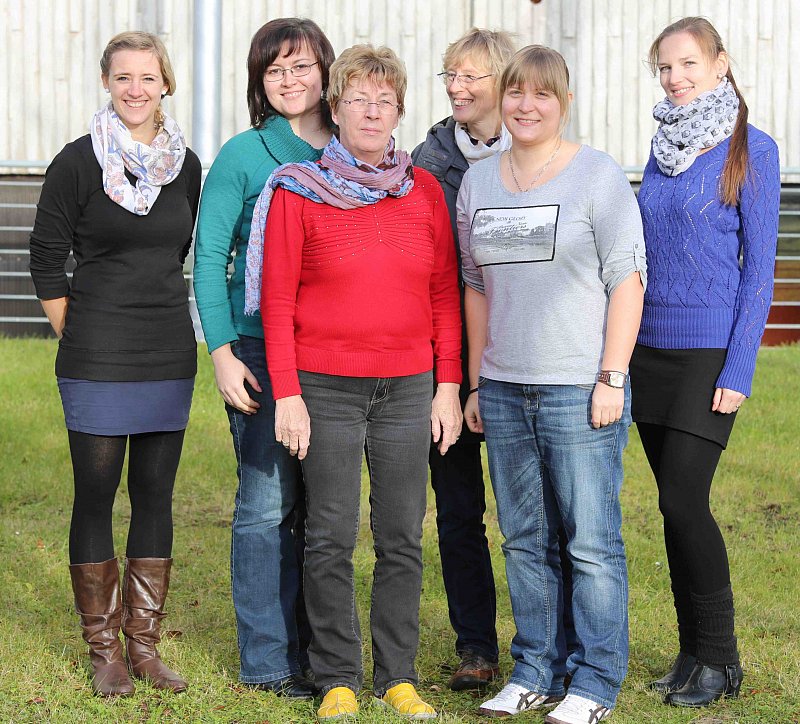
from left: Stefanie Hartwig, Marlén Pöritz, Bärbel Zessin, Ute Lechner, Ulrike Heinemann, Lydia Krasper
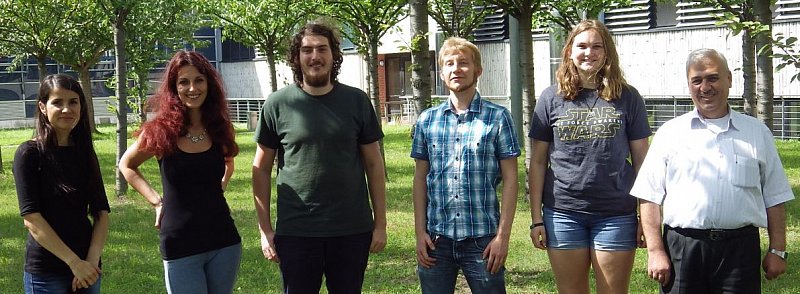
Lab 204+212 in August 2016 - from left: Nadya Krumova, Franziska Greiner-Haas, Christian Blumenscheit, Stefan Schwoch, Cassidy Schneider, Dr. Hassan Al-Fathi
PUBLICATIONS
Lechner U., Türkowsky, D., Dinh, T.T.H., Al-Fathi, H., Schwoch, S., Franke, S., Gerlach, M.-S., Koch, M., von Bergen, M., Jehmlich, N., Dang, T.C.H. (2018) Desulfitobacterium contributes to the microbial transformation of 2,4,5-T by methanogenic enrichment cultures from a Vietnamese active landfill, Microb. Biotechnol. 11(6):1137-56 (doi: 10.1111/1751-7915.13301).
Nijenhuis, I., Stollberg, R. and Lechner, U. (2018) Anaerobic microbial dehalogenation and its key players in the contaminated Bitterfeld-Wolfen megasite. FEMS Microbiol. Ecol. 94 (4) (doi: 10.1093/femsec/fiy012).
Kruse, T., Goris, T., Maillard, J., Woyke, T., Lechner, U., de Vos, W. and Smidt, H. (2017) Comparative genomics of the genus Desulfitobacterium. FEMS Microbiol. Ecol. 93 (12) (doi: 10.1093/femsec/fix135).
Hartwig, S., Dragomirova, N., Kublik, A., Türkowsky, D., von Bergen, M., Lechner, U., Adrian, L. and Sawers, R.G. (2017) A H2-oxidizing, 1,2,3-trichlorobenzene-reducing multienzyme complex isolated from the obligately organohalide-respiring bacterium Dehalococcoides mccartyi strain CBDB1. Environ Microbiol Rep. 9, 618-625 (doi: 10.1111/1758-2229).
Krasper, L., Lilie, H., Kublik, A., Adrian, L., Golbik, R. and Lechner, U. (2016) The MarR-type regulator Rdh2R regulates rdh gene transcription in Dehalococcoides mccartyi CBDB1. J. Bacteriol. 198, 3130-3141 (doi: 101128/JB.00419-16).
Kruse, T., Smidt, H. and Lechner, U. (2016) Comparative genomics and transcriptomics of organohalide-respiring bacteria and regulation of rdh gene transcription. In: Adrian. L. and Löffler, F. (Eds.) Organohalide-respiring bacteria. Springer, Berlin Heidelberg, p. 345-376.
Pöritz, M., Schiffman, C., Hause, G., Heinemann, U., Seifert, J., Jehmlich, N., Von Bergen, M., Nijenhuis, I. and Lechner, U. (2015) Dehalococcoides mccartyi strain DCMB5 respires a broad spectrum of halogenated aromatic compounds. Appl. Environ. Microbiol. 81, 587-596.
Kosowski, K., Schmidt, M., Pukall, R., Hause, G., Kämpfer, P. and
Lechner, U. (2014) Bacillus pervagus sp. nov. and Bacillus andreesenii sp. nov. isolated from a composting reactor. Int. J. Syst. Evol. Microbiol. 64, 88-94. DOI: 10.1099/ijs.0.054833-0.
Wagner, A., Segler, L., Kleinsteuber, S., Sawers, G., Smidt, H. and Lechner, U. (2013) Regulation of reductive dehalogenase gene transcription in Dehalococcoides mccartyi. Phil. Trans. R. Soc. B 368, 20120317.
Pöritz, M., Goris, T., Wubet, T., Tarkka, M. T., Buscot, F., Nijenhuis, I., Lechner, U. and Adrian, L. (2013) Genome sequences of two dehalogenation specialists – Dehalococcoides mccartyi strains BTF08 and DCMB5 enriched from the highly polluted Bitterfeld region. FEMS Microbiol. Lett. 343, 101-104. DOI: 10.1111/1574-6968.12160.
Wagner, V., Antunes, P. M. , Ristow, M., Lechner, U., and Hensen, I. (2011) Prevailing negative soil biota effect and no evidence for local adaptation in a widespread Eurasian grass. PloS ONE 6: e17580.
Bensel, T., Stotz, M., Borneff-Lipp, M., Wollschläger, B., Wienke, A., Taccetti, G., Campana, S., Meyer, K., C., Jensen, P., Ø., Lechner, U., Ulrich, M., Döring, G., Worlitzsch, D. (2011) Lactate in cystic fibrosis sputum. J. Cyst. Fibros. 10, 37–44.
Bunge, M., Lechner, U. (2009) Anaerobic reductive dehalogenation of polychlorinated dioxins. Appl. Microbiol. Biotechnol. 84, 429-444.
Wagner, A., Adrian, L., Kleinsteuber, S., Andreesen, J. R., Lechner, U. (2009) Transcription analysis of genes encoding homologues of reductive dehalogenases in "Dehalococcoides" sp. strain CBDB1 by using terminal restriction fragment length polymorphism and quantitative PCR. Appl. Environ. Microbiol. 75, 1876-1884.
Bunge, M., Wagner, A., Fischer, M., Andreesen, J. R., Lechner, U. (2008) Enrichment of a dioxin-dehalogenating Dehalococcoides species in two-liquid phase cultures. Environ. Microbiol. 10, 2670-2683.
Ewald, E.-M., Wagner, A., Nijenhuis, I., Richnow, H.-H., Lechner, U. (2007) Microbial dehalogenation of trichlorinated dibenzo-p-dioxins by a Dehalococcoides-containing mixed culture is coupled to carbon isotope fractionation. Environ. Sci. Technol. 41, 7744-7751.
Breitenstein, A., Andreesen, J. R., Lechner, U. (2007) Analysis of an anaerobic chemostat population stably dechlorinating 2,4,6-trichlorophenol. Eng. Life Sci. 7, 380-387.
Lechner, U., Brodkorb, D., Geyer, R., Hause, G., Härtig, C., Auling, G., Fayolle-Guichard, F., Piveteau, P., Müller, R. H., Rohwerder, T. (2007) Aquincola tertiaricarbonis gen. nov., sp. nov., a tertiary butyl moiety-degrading bacterium. Int. J. Syst. Evol. Microbiol. 57, 1295-1303.
Bunge, M., Kähkönen, M. A., Rämisch, W., Opel, M., Vogler, S., Walkow, F., Salkinoja-Salonen, M., Lechner, U. (2007) Biological activity in a heavily organohalogen-contaminated river sediment. ESPR – Environ. Sci. Pollut. Res. 14, Special Issue, 1-3.
Rohwerder, T., Breuer, U., Benndorf, D., Lechner, U., Müller, R. H. (2006) The alkyl tert-butyl ether intermediate 2-hydroxyisobutyrate is degraded via a novel cobalamin-dependent mutase pathway. Appl. Environ. Microbiol. 72, 4128-4135.
Lechner, U., Bunge, M., Adrian, L. (2004) Reduktive Dehalogenierung von chlorierten Benzolen und Dioxinen. Biospektrum10, Heft 5/04, 630-632.
Ballerstedt, H., Hantke, J., Bunge, M., Werner, B., Gerritse, J., Andreesen, J. R., Lechner, U. (2004) Properties of a trichlorodibenzo-p-dioxin-dechlorinating mixed culture with a Dehalococcoides as a putative dehalogenating species. FEMS Microbiol. Ecol. 47, 223-234.
Adrian, L., Lechner, U. (2004) Reductive dehalogenation of polychlorinated benzenes and dioxins. In: Nakano, M. M., and Zuber, P., Strict and facultative anaerobes. Medical and environmental aspects, Horizon Bioscience, Norfolk, England, pp. 303-315.
Bunge, M., Adrian, L., Kraus, A., Opel, M., Lorenz, W. G., Andreesen, J. R., Görisch, H., Lechner, U. (2003) Reductive dehalogenation of chlorinated dioxins by an anaerobic bacterium, Nature 421, 357-360
Breitenstein, A., Wiegel, J., Haertig, C., Weiss, N., Andreesen, J. R., Lechner, U. (2002) Reclassification of Clostridium hydroxybenzoicum as Sedimentibacter hydroxybenzoicus gen. nov., comb. nov. and description of Sedimentibacter saalensis sp. nov. Int. J. Syst. Evol. Microbiol. 52, 801-807.
Breitenstein, A., Saano, A., Salkinoja-Salonen, M., Andreesen, J. R., Lechner, U. (2001) Analysis of a 2,4,6-trichlorophenol-dehalogenating mixed culture and isolation of the dehalogenating member Desulfitobacterium frappieri strain TCP-A. Arch. Microbiol. 175, 133-142.
Bunge, M., Ballerstedt, H., Lechner, U. (2001) Regiospecific dechlorination of spiked tetra- and trichlorodibenzo-p-dioxins by anaerobic bacteria from PCDD/F-contaminated Spittelwasser sediments. Chemosphere, 43, 675-681.
Bunge, M, Lechner, U. (2001) Anaerobic transformation of dioxins by bacteria from contaminated sediments: diversity of the dehalogenating community. In: Schriftenreihe des Sonderforschungsbereiches 193 der Technischen Univeristät Berlin „Biologische Behandlung industrieller und gewerblicher Abwässer", Bd. 15: Anaerobic dehalogenation, S. 69-81.
Bunge, M., Werner, B., Lechner, U. (2000) Properties of a dioxin-dechlorinating microbial consortium from an acidic sulfate-rich river sediment. Organohalogen Compounds, 45, 456-459.
Bunge, M., Ballerstedt, H., Lechner, U. (1999) Different regioselectivities of reductive dioxin-dechlorination by anaerobic bacteria from river sediments of the Bitterfeld district. Organohalogen Compounds 41, 387-390.
Fritsche, K., Lechner, U. (1999). Defluvibacter lusatiae gen. nov., sp. nov., a new chlorophenol-degrading member of the -2 subgroup of the Proteobacteria. System. Appl. Microbiol. 22, 197-204.
Ballerstedt, H., Werner, B., Gerritse, J., Lechner, U. 1998. Anaerobic bacteria from sediments dechlorinate dioxin congeners. In: Microbiology of polluted aquatic ecosystems, pp. 58-64 (Becker, P. M., ed.). Proceedings of the workshop held at UFZ, Leipzig 4.-5. Dec. 1997.
Fritsche, K., Lechner, U. 1998. Molecular biology of chlorophenol degradation catalyzed by a bacterium of the Rhizobiaceae group. In: Microbiology of polluted aquatic ecosystems, pp. 102-108 (Becker, P. M., ed.). Proceedings of the workshop held at UFZ, Leipzig 4.-5. Dec. 1997.
Ballerstedt, H., Kraus, A., Lechner, U. 1997. Reductive dechlorination of 1,2,3,4-tetrachlorodibenzo-p-dioxin and its products by anaerobic mixed cultures from Saale river sediment. Environ. Sci. Technol. 31, 1749-1753.
Makdessi, K., Lechner, U. 1997. Purification and characterization of 2,4-dichlorophenol hydroxylase isolated from a bacterium of the alpha-2 subgroup of the Proteobacteria. FEMS Microbiol. Lett. 157, 95-101.
Lechner, U., Baumbach, R., Becker, D., Kitunen, V., Auling, G., Salkinoja-Salonen, M. 1995. Degradation of 4-chloro-2-methylphenol by an activated sludge isolate and its taxonomic description. Biodegradation 6, 83-92.