Links
Login für Redakteure

Forschung
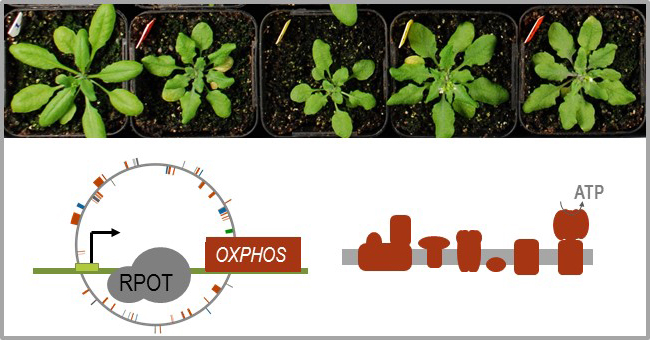
Research in our laboratory mainly focuses on the transcription of mitochondrial and chloroplast genomes and on post-transcriptional processes in these energy-converting organelles. We are additionally studying mitochondrial biogenesis and function and energy metabolism in plants (research by Dr. Etienne Meyer). Most of our work is done using the model plant Arabidopsis thaliana.
Our research uses
- Transgenic plants for reverse-genetic approaches
- Various techniques for high- and low-throughput analyses of organelle transcripts and for transcript end mapping
- differential RNA sequencing (dRNA-Seq) and nascent transcript sequencing (GRO-Seq, 5’ GRO-Seq)
- Cell fractionation techniques
- In organello assays for monitoring mitochondrial transcription and translation
- Native PAGE and respiration assays for studying the mitochondrial oxidative phosphorylation system
Currently funded projects
Role of a dual-targeted organellar RNA polymerase in controlling organelle function (DFG Research Training Group 2498 project P08)
The discovery that the nucleus-encoded RNA polymerase RPOTmp is dually targeted to both mitochondria and plastids raised the question whether this enzyme may serve to co-ordinate metabolic functions in the two organelles. Answering this question will require to i) comprehensively determine transcriptional tasks of RPOTmp in mitochondria and plastids and ii) investigate how this enzyme’s activity and subcellular targeting are controlled. We are employing next generation sequencing-based approaches to determine promoters used and genes transcribed by RPOTmp in mitochondria. This work is complemented with investigations of the partitioning of RPOTmp between mitochondria and plastids. In addition, we are scrutinising prior observations of stimulated mitochondrial transcription in plants that are impaired in mitochondrial energy conversion.
See RTG 2498 website for more information.

Control of complex I proteostasis in plants (Dr. Etienne Meyer)
Cellular respiration is a key metabolic pathway as it is producing the ATP necessary to fuel metabolism and growth. In plants, the activity of respiration has also been shown to influence intracellular signaling pathways. Therefore, the control of the respiratory activity is essential to optimise plant growth. We have recently shown that complex I, the first enzyme of the mitochondrial respiratory chain, acts as a negative regulator of respiratory fluxes. The aim of this project is to elucidate the machinery and mechanisms that guarantee and regulate complex I proteostasis in plants. We will first characterize the assembly pathway of complex I. In addition, we will dissect the mechanistic involvement of newly identified candidate proteins in the control of complex I abundance. We identified these proteins through a bioinformatics screen and we already confirmed that they are important for complex I proteostasis. Their characterisation will highlight the importance of fatty acid metabolism for complex I function and uncover novel functions that were acquired in the context of the unique metabolic setup of plants, as some of these proteins do not have obvious homologues in animals and fungi.